EXPLORE THE BOOK
Parenting Wrong: Turning “Oops!” into “a-Ha!”
Transforming Generational Traumas for Family Growth
Parenting doesn't come with an instruction manual.
And even if it did, our children probably wouldn't follow it.
Every parent has moments when things don't go as planned.
The milk spills.
The child says no.
The shoes won't go on.
The conversation goes sideways.
And suddenly... you're the one losing it!
Oops.
But what if that moment isn't a failure?
What if there's an “a-Ha!” hiding inside the “Oops!”?
Six Big Ideas at the Heart of Parenting Wrong
1. Connection & Communication
Understand your child—and help your child understand you.
2. Cooperation & Everyday Parenting
Turn everyday battles into opportunities to teach, connect,
and grow.
3. Boundaries & Behavior
Set limits without losing the relationship.
4. Emotional Intelligence & Empathy
Look beneath the behavior to discover what your child
may really be communicating.
5. Breaking the Cycle
Recognize what you inherited—and decide what you
pass on.
6. The Parent Behind the Parenting
Meet the person, experiences, frustrations, and
“Louie-Isms” behind the book.
A Closer Look...
CHAPTER 1: “Oops!” Go Ahead, Spill the Milk!
What If the Spilled Milk Isn't the Problem?
The milk spills.
A glass breaks.
Something gets knocked over.
And suddenly, a small accident can become a big emotional moment.
But what if the spilled milk isn't really the problem?
What if our reaction to the spilled milk is the bigger parenting opportunity?
A child who accidentally makes a mess doesn't necessarily need a lecture, a punishment, or a frustrated parent.
Sometimes they need something much simpler:
A parent who can stay calm enough to turn a mistake into a lesson.
Because accidents happen.
Mistakes happen.
And parenting doesn't have to be about making sure our children never make them.
It's about teaching them what to do when they do.
This is where the idea behind Parenting Wrong begins:
What if the moments we think we've gotten wrong are actually opportunities to get something right?
CHAPTER 7: “Five Magic Minutes”
What Your Child Really Wants
What if five minutes could make a bigger difference than an entire afternoon?
Children don't necessarily need more things.
More toys.
More activities.
More entertainment.
Sometimes what they really want is much simpler:
You.
Not your phone.
Not your to-do list.
Not half of your attention while you're doing something else.
You.
Five uninterrupted minutes of genuine attention can send a powerful message to a child:
You're important to me.
This chapter explores how a surprisingly small investment of your time can create a surprisingly big change in connection.
Because sometimes your child isn't asking for more.
They're asking for you to be there.
CHAPTER 10: “Stop Saying ‘Okay?’”
Well, Okay!
“Time to go, okay?”
“Put your shoes on, okay?”
“We're leaving now, okay?”
We've all said it.
And usually, we're not actually asking a question.
So why do we say “okay?” Because that tiny word can unintentionally change the message we're sending.
What sounds like a simple parental directive can suddenly sound like an invitation:
“Would you like to do this?”
And if the child says no...
Well, now we have a negotiation.
This chapter takes a surprisingly close look at one little word—and how changing the way we communicate expectations can sometimes prevent an unnecessary parenting battle before it begins.
It's not about becoming more demanding.
It's about becoming clearer.
Sometimes a tiny change in language can create a very different response.
Okay?
CHAPTER 5: “I Was Wrong”
Okay. I Can Make It Right.
There's something difficult about saying these three words to your child:
I was wrong.
Parents are supposed to be the ones who know.
The ones who lead.
The ones who have the answers.
But what happens when we don't?
What happens when we lose our patience?
Misunderstand our child?
Say something we shouldn't have said?
What if admitting it doesn't weaken our authority?
What if it strengthens trust?
When a parent can say, “I was wrong,” a child learns something much more valuable than simply seeing a parent who is always right.
They learn that mistakes can be acknowledged.
That responsibility matters.
That apologies can be sincere.
And perhaps most importantly:
That relationships can be repaired.
Because being a good parent doesn't mean never getting it wrong.
Sometimes it means having the courage to make it right.
CHAPTER 8: “Damage Control!”
Quick! Activate Your Emotional Power Tools!
Parents are going to make mistakes.
Children are going to get hurt.
Feelings are going to get bruised.
That's parenting.
The question isn't whether emotional damage will ever happen.
It's: What do you do when it does?
Maybe you yelled.
Maybe you reacted too quickly.
Maybe your child misunderstood something you said.
Maybe you were simply having a bad day.
Now what?
This chapter explores one of the most important—and often overlooked parts of parenting:
Repair.
Repair doesn't mean pretending nothing happened.
It means recognizing what happened, reconnecting with your child, and helping you both move forward.
Because perfection isn't the goal.
Connection is.
And sometimes one of the most powerful parenting tools isn't preventing every mistake.
It's knowing what to do after the mistake happens.
Because repair isn't a sign that you've failed at parenting.
Repair is part of Parenting 101.
CHAPTER 31: “Generational Trauma”
Yesterday, Today, and Tomorrow… Gone.
Sometimes we're parenting from a script we never consciously chose.
We repeat words we heard as children.
React in ways our parents reacted.
Carry beliefs we inherited without ever stopping to question them.
And then one day...
We hear ourselves say something to our child and suddenly realize:
“Oh, my God. I sound just like my parent.”
That's the moment when something changes.
Because before we can change a pattern, we have to recognize it.
Parenting Wrong asks a difficult—and deeply important question:
What if we can change what gets passed down?
Breaking a generational pattern isn't about blaming the generations before us. It's about understanding what happened.
Recognizing how it affected us.
And deciding what happens next.
Maybe something that was handed down to you doesn't have to be handed down to your child.
Maybe you can be the place where the pattern ends.
Yesterday. Today. And tomorrow… gone.
Your Next “a-Ha!” Moment
These are only six of the moments inside Parenting Wrong.
Six moments where an ordinary parenting situation can suddenly look very different.
Because Parenting Wrong isn't about becoming a perfect parent. It's about becoming a more aware parent.
A parent who can look at the spilled milk and see a teaching moment.
A parent who can hear “NO!” and see a child discovering independence.
A parent who can say:
“I was wrong.”
A parent who can repair.
A parent who can listen.
A parent who can respond rather than react.
And maybe...
A parent who can recognize a pattern that's been passed down for generations and decide: It stops with me.
Because sometimes the biggest parenting breakthroughs begin with the smallest realization: "Maybe I'm looking at this wrong."
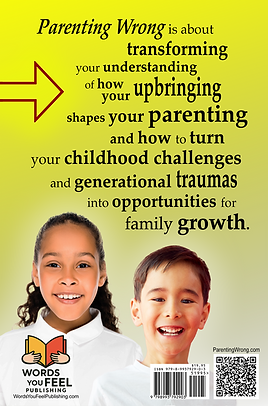
That's the journey of "Parenting Wrong, Turning 'Oops!' into 'a-Ha!' Transforming Generational Trauma for Family Growth."
More Parenting Wrong “a-Ha!” Moments
-
Chapter 22: Parenting Hack #7: "Food on the Floor"
What if the food isn't really the problem?
-
Chapter 15: "Because I Said So!"
When does authority become a substitute for communication?
-
Chapters 23 & 24: "No Means No," Parts 1 & 2
What can a child's “no” teach us about independence, boundaries, and respect?
-
Chapter 28: Parenting Hack #9: "Sometimes, It’s Not About the Bandage"
What if the hurt isn't where you think it is?
-
Chapters 26 & 27: "Stop Means Stop," Parts 1 & 2: When “Stop” isn't a suggestion.
-
Chapter 21: "Screen Scream!"
Who's really in control—the child or the screen?
-
Chapter 30: "Parenting Hack #10: This Is Difficult To Talk About.
The conversation you may not want to have—but need to.
-
Chapter 16: Parenting Hack #5: "The Broccoli Challenge"
Maybe the broccoli isn't the problem.

Ready for More “a-Ha!” Moments?
Discover the full journey inside Parenting Wrong: Turning “Oops!” into “a-Ha!”
Softcover, Hardcover, Audiobook, Kindle
Available on
